By Keith Garner
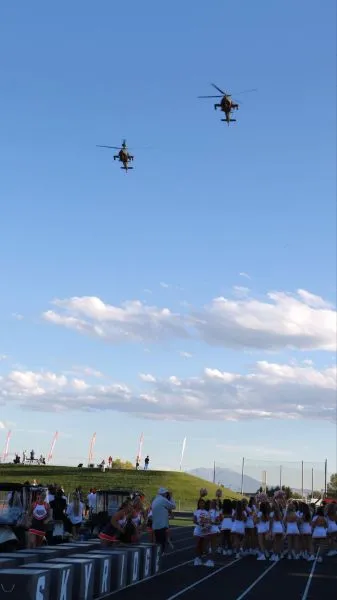
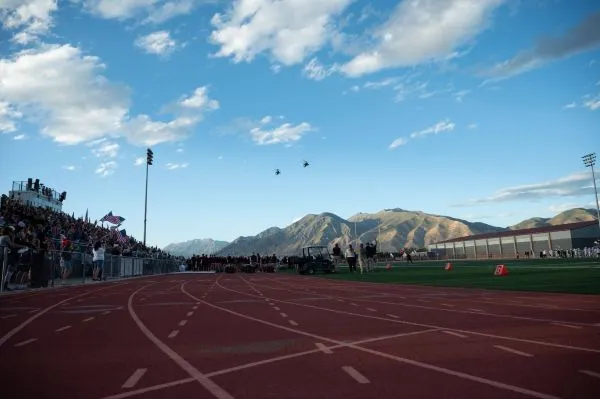
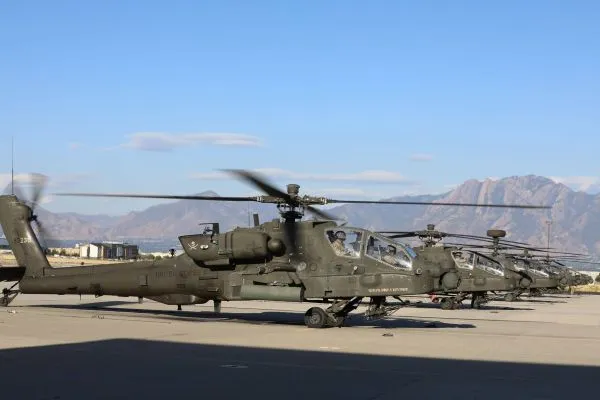
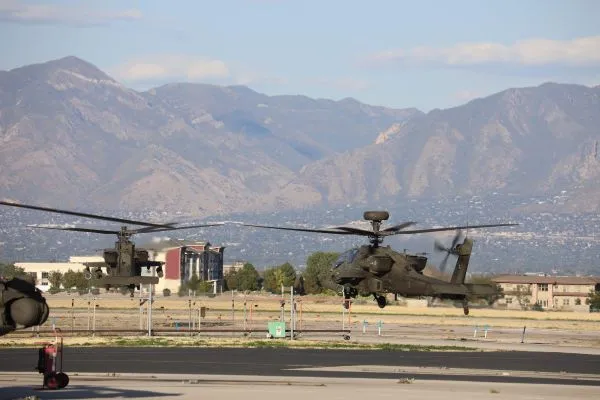
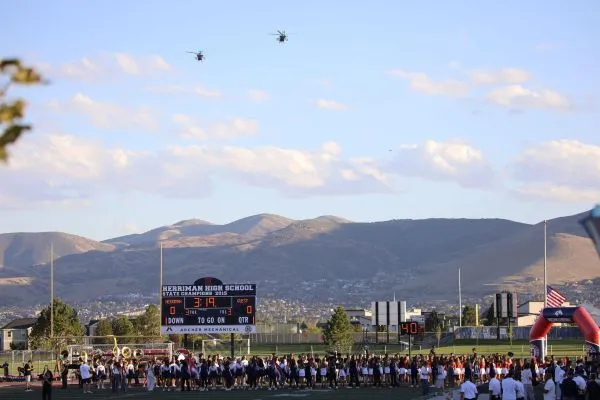
West Jordan, Utah – Ten AH-64E Apache Guardian helicopters from the Utah Army National Guard’s 1st Battalion, 211th Aviation Regiment flew over 27 high school football stadiums along the Wasatch Front in a 19-minute window Friday night, marking 25 years since the Sept. 11, 2001, attacks.
The mission, called Operation Friday Night Flights, sent 20 aircrew members down five routes from Ogden to Spanish Fork. Every game kicked off at 7 p.m., so every flyover had to land in the minutes before it. The first aircraft crossed its 50-yard line at 6:48:30 p.m. The last crossed at 7:04:30 p.m.
“This is a once in a lifetime opportunity to join with our fellow community members in commemorating a milestone of the tragic events of 9/11 that shaped a generation,” said Lt. Col. Robert Heightman, commander of the 1-211th. “On this day, we hope to bring back the unity that the nation felt on September 12, 2001. What better way to do that than by celebrating a hallmark of our way of life…Friday Night Lights.”
Heightman told his aircrews the mission grew out of the story of Todd Beamer, a passenger on United Airlines Flight 93. After hijackers took the cockpit, Beamer reached a phone operator, learned what had happened at the World Trade Center and the Pentagon, and told her the passengers were going to take the plane back. The operator recalled his last words on the line: “Are you ready? Okay. Let’s roll.” The plane went down in a field near Shanksville, Pennsylvania, short of its target.
“We have crew members and maintainers who weren’t even born on September 11th. They are Gen X, Y, Z, etc. all in the Battalion. But all of us are part of the ‘Let’s Roll’ generation because they all stood up, raised their right hand and volunteered to defend our nation,” Heightman said.
Flying was the easy part. The hard part was the clock. Once a flight of two Apaches lifted off, it flew a fixed track at a fixed speed. Crews could not slow down for one stadium without pushing every stadium behind it late. That meant a school running long on its pregame did not get a later flyover, and a school running early did not get an early one. Planners surveyed the 50-yard line of all 27 stadiums, loaded the coordinates into the mission planning system, and assigned each school a crossing time to the second. Two schools on the same route were as little as 90 seconds apart.
“We told the schools to build their pregame backward from their time on target,” said Capt. Conayn Freebairn, the battalion’s assistant operations officer and lead planner. “If you want the aircraft at the last note of the anthem, your singer has to rehearse with a stopwatch. Most singers speed up when they’re nervous. The Apache doesn’t.”
Airspace added another layer. The five routes crossed Salt Lake City International Airport’s Class B airspace and the Class D airspace around Hill Air Force Base, Ogden-Hinckley Airport and Provo Airport. Crews coordinated in advance with Salt Lake Approach and the towers at Hill, Ogden and Provo, and monitored ADS-B for general aviation traffic. On the Salt Lake West route, crews planned around the Pioneer Valley Hospital helipad near Granger High School. On the Davis County route, Northridge High School sits less than a mile off the extended centerline of Hill’s Runway 32.
The “Air Pirates” were among the first National Guard units to field the Apache when it arrived in Utah in 1992. The battalion has deployed multiple times to Afghanistan in support of Operation Enduring Freedom and is now converting to the AH-64E, with the first of 24 new aircraft arriving in November 2024. The unit flies from the Army Aviation Support Facility at South Valley Regional Airport in West Jordan.